


An informal metrological audit, statistical critique, and regulatory failure analysis of Pangram's evaluation report on ESL student writing.
Reference Article: Pangram Labs — Benchmarking False Positives on College Essays
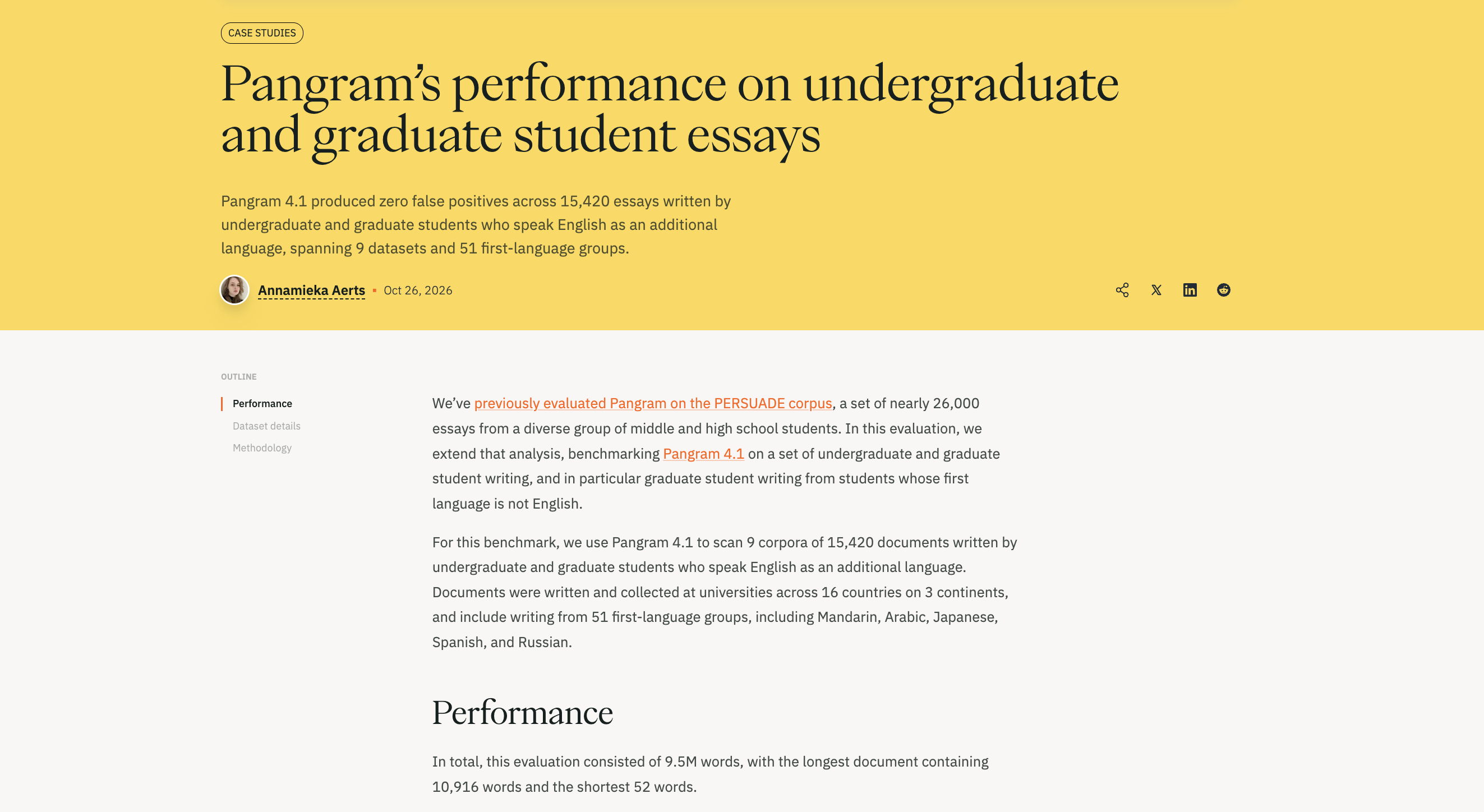
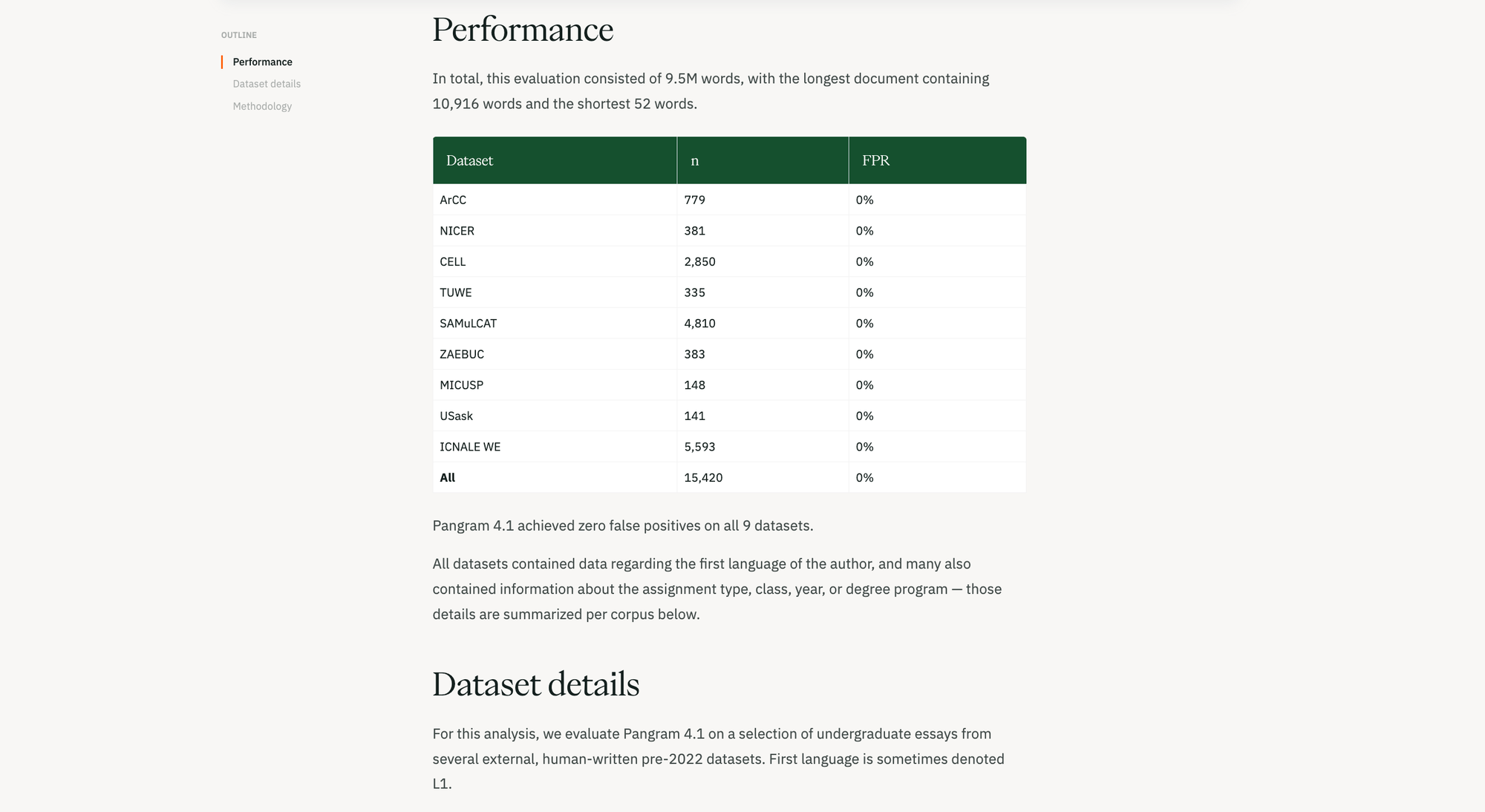
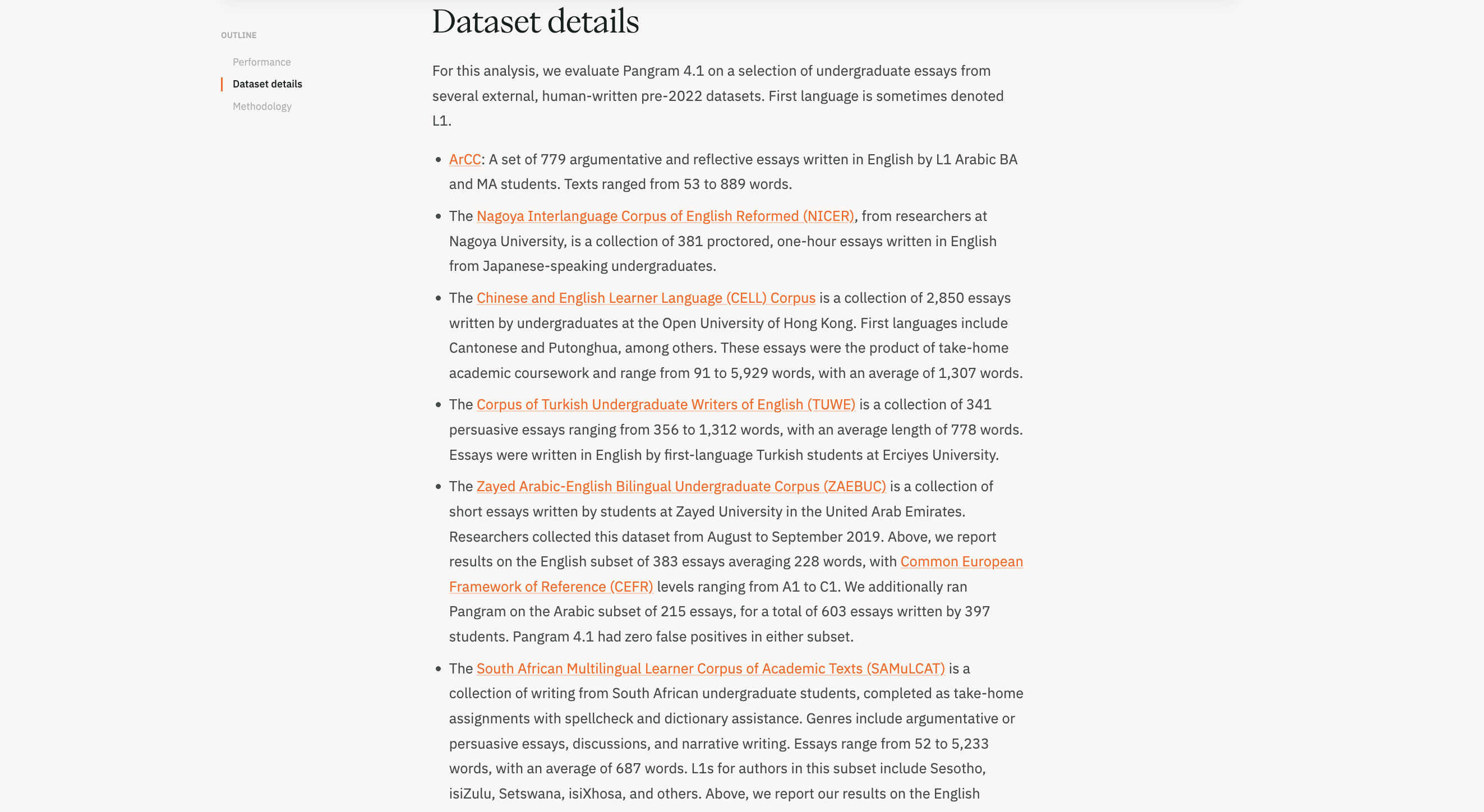
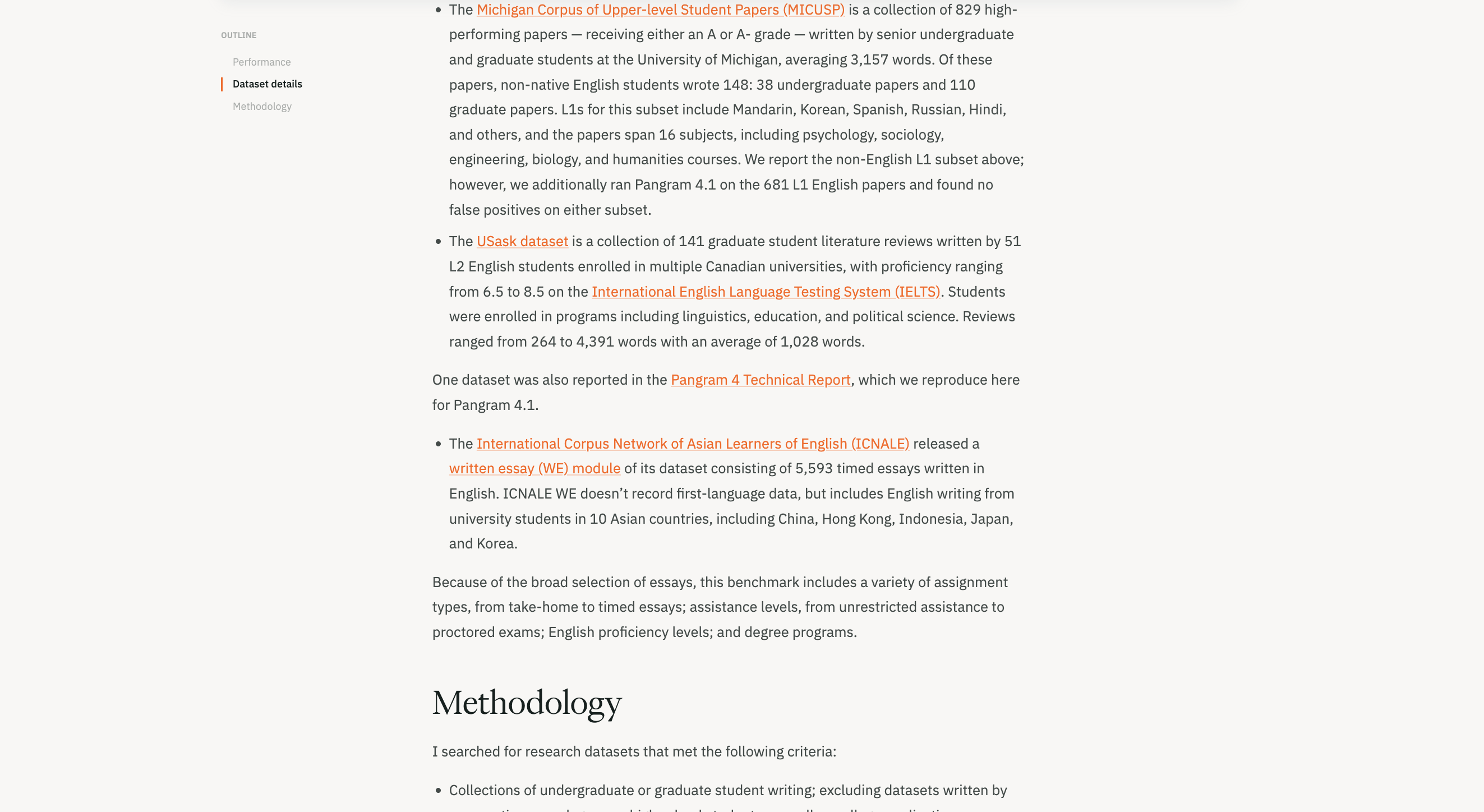
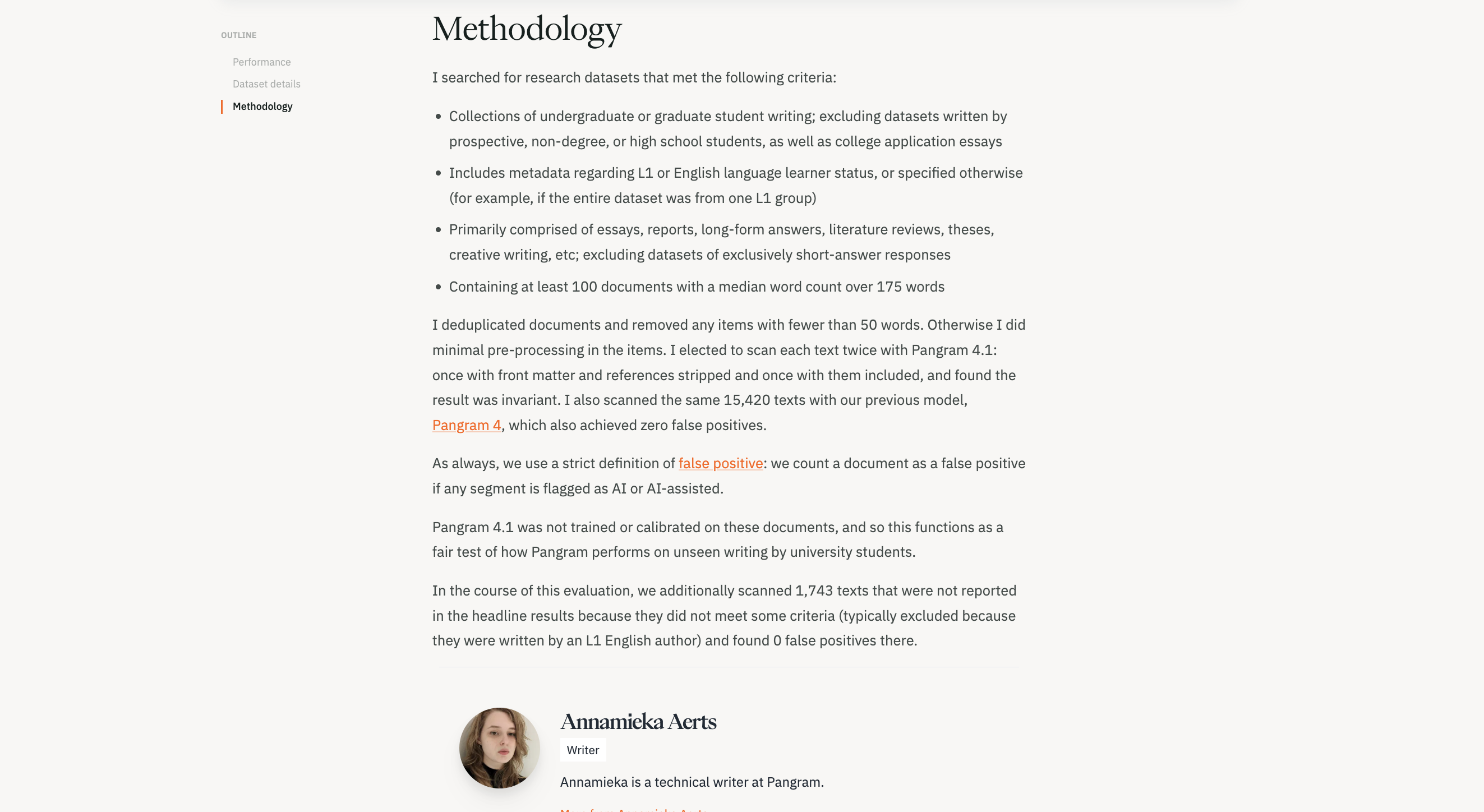
Executive Summary & Visual Audit
The benchmark published by Pangram claims a 0.0 % False Positive Rate (FPR) across 9 historical corpora comprising 15,420 student essays (9.5M words). When subjected to the analytical frameworks required by ISO/IEC 25010 (Software Quality Requirements), ISO 5725 (Accuracy and Trueness of Measurement Methods), and regulatory standards from pharmacology and clinical diagnostics (ICH E9, FDA 21 CFR §814), the published data exhibits fatal structural, statistical, and sampling flaws.
1. ISO Standards Conformance Evaluation
An evaluation conducted under ISO/IEC 25010:2023 (Systems and software Quality Requirements and Evaluation), ISO/IEC 24029-1 (Assessment of Neural Network Robustness), and ISO 5725-1/-2 (Accuracy, Trueness, and Precision) identifies critical non-conformities:
The corpus word counts range from 52 words up to 10,916 words (a factor spread of 210 times).
Document Length vs. Segment Exposure Hazard
Short (52 words):   [ S1 ]  (m = 1)   --> Hazard: 1 - (1 - ε)^1  ≈ ε
Long (10,916 wds):  [ S1 ][ S2 ][ S3 ] ... [ Sm ]  (m ≈ 150) --> Hazard: 1 - (1 - ε)^150 ≈ 150ε
By pooling a 52-word excerpt with a 10,916-word academic thesis into an unweighted Bernoulli denominator, the benchmark conflates document length with model specificity.
3. Why This Benchmark Fails Regulatory & Clinical Standards
If this evaluation were submitted as a non-inferiority or diagnostic validity study to the FDA (CDRH / CDER), EMA, or an institutional Data Safety Monitoring Board (DSMB), it would face immediate regulatory rejection.
4. Methodological Remediation Protocol
To elevate this benchmark to an acceptable scientific and metrological standard, the evaluation framework must undergo structural redesign:
                       REMEDIATED BENCHMARK PROTOCOL
  ┌────────────────────────────────────────────────────────────────────────┐
  │ 1. Paired Bimodal Testing Suite                                        │
  │    ├─ Class 0 (Human L2): n = 15,420 (Historical + Modern Control)    │
  │    └─ Class 1 (AI Generation): n = 15,420 (LLM-matched prompts)        │
  ├────────────────────────────────────────────────────────────────────────┤
  │ 2. Continuous Output Metrics                                           │
  │    ├─ Brier Score Calibration Plot: B = (1/N) Σ (f(x) - y)²            │
  │    ├─ Full ROC Envelope with Area Under Curve (AUC-ROC)                │
  │    └─ Intraclass Correlation Adjustment (Cluster-robust Huber-White)   │
  ├────────────────────────────────────────────────────────────────────────┤
  │ 3. Standardised Exposure Windows                                       │
  │    └─ Evaluation over fixed sliding windows (e.g., L = 250 tokens)      │
  │       to eliminate segment-length hazard rate bias                     │
  └────────────────────────────────────────────────────────────────────────┘
Conclusion
The benchmark published in Pangram's article demonstrates that on a retrospective collection of pre-2022 human texts, Pangram 4.1 did not cross its internal classification threshold.
However, presenting this as proof of an invariant 0% False Positive Rate violates fundamental metrological principles (ISO 5725), statistical estimation theory (Clopper-Pearson limits), and regulatory diagnostic trial criteria. Without concurrent positive control validation, calibration curves, or hierarchical variance accounting, the conclusions remain mathematically incomplete and scientifically unproven.
Important further reading:
Author Biography
Lloyd Lewis, PhD, is a retired pharmacologist and the founder of Art of FACELESS, an independent, artist-led studio and research project based in Cardiff, Wales, United Kingdom. Drawing on a professional background in pharmacology, neuroscience, and quantitative methodology, his work examines automated detection architectures, data sovereignty, and the empirical limits of algorithmic systems through transmedia art and rigorous technical critique.
Comment Policy, Disclaimer & Right of Reply
Disclaimer
The analyses, critiques, and commentary published on this site represent independent technical, statistical, and conceptual research conducted through Art of FACELESS. All evaluations of third-party software, commercial benchmarks, and published literature are provided for educational, critical, and analytical purposes under standard principles of academic review and fair dealing.
Right of Reply & Moderated Comments
We welcome substantive engagement, technical rebuttals, and methodological corrections. To maintain civil, verified, and accountable discourse, the comments section is strictly moderated:
- Formal Registration Required: Active commenting and formal rights of reply are open exclusively to verified, signed-up members of this platform. Anonymous or unauthenticated submissions are not permitted.
- Standards of Engagement: Comments and formal responses should address the underlying methodology, mathematics, or empirical data presented in the text. We reserve the right to decline or remove bad-faith contributions, commercial solicitation, or non-substantive abuse.
- Institutional Responses: Representatives of organisations, research groups, or commercial entities critiqued in these pages who wish to exercise a formal right of reply are invited to submit their verified response either directly through their registered account or via formal correspondence for public inclusion.


