No Face. No Performance. No Proof Required.
Demanding that disabled people justify the tools they live and work with is offensive, degrading and discriminatory.
Founding editorial
Art of FACELESS · since 2012
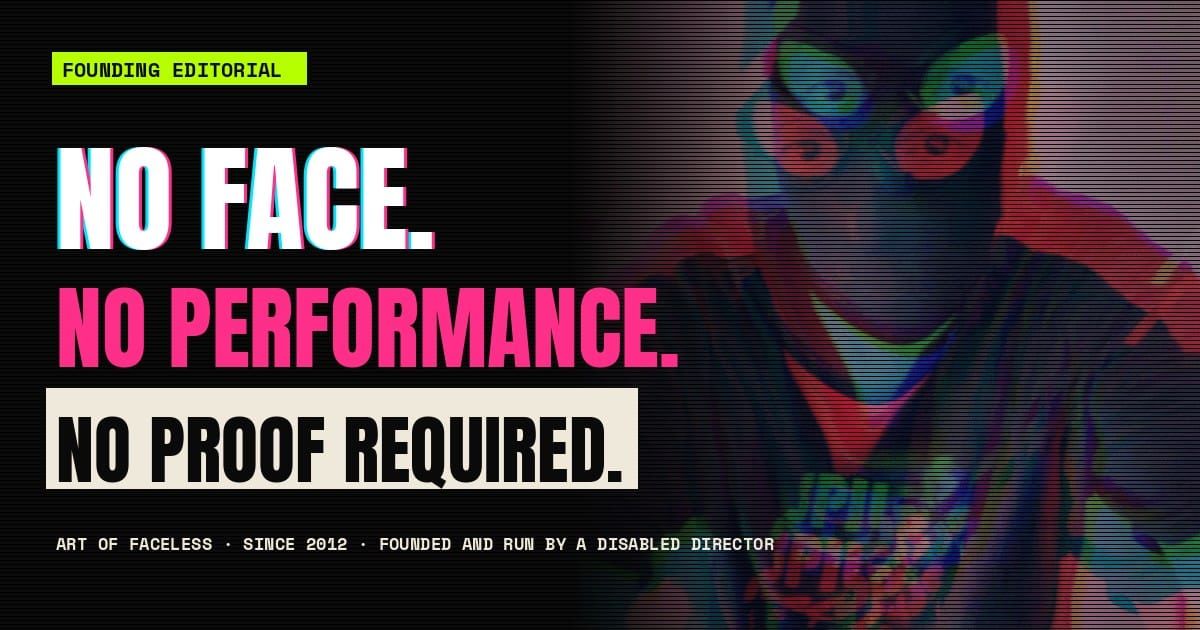
No Face. No Performance. No Proof Required.
This is the founding editorial of the new Art of FACELESS. Everything we publish from today comes back to it.
We'll say it once, loud, and then we're done saying it:
Demanding that disabled people justify the tools they live and work with is offensive, degrading and discriminatory.
That goes for the wheelchair, the hearing aid, the screen reader, the scheduling bot, the automation pipeline and the AI that lets a disabled person keep working. Nobody gets to demand a disabled person's reasons, and nobody is owed a performance.
So here's the new line, and every word of it is a position.
No Face.
Since 2012
Art of FACELESS started in 2012 on one principle: Facelessness is Freedom.
People thought it was an aesthetic. It wasn't. It was a mental health position. It came from knowing what it costs to be looked at, read, scored, and judged by people who decide what you are before you've opened your mouth. The mask wasn't hiding anything. It was refusing to hand over the thing everyone wanted, a face they could use to decide whether you were real.
Almost fifteen years later, that demand is back, aimed at disabled people and turned up to full volume. Show us your file. Show us your diagnosis. Show us your worst day, on camera, in person, in a forty-page form. Let the man in the car park take a look. Let the woman in the supermarket decide.
No.
You don't need our face to know we're telling the truth. You never did.
No Performance.
Disabled people are expected to perform disability, and to do it convincingly: suffering at the right volume, struggling at the approved speed, looking the part. Too well, and you're faking. Too ill, and you're a burden. There's no score that passes.
Here's what fluctuating conditions actually look like. It's a sliding scale, not a switch:
- 0
- 50
- 70
- 100
A 70 doesn't cancel out a 0. A good day isn't a confession.
Any system, assessor or commenter that treats one good day as evidence against every bad one isn't confused about disability. It's looking for a reason to say no.
We won't act out our worst days to earn belief. We work at whatever number the day gives us, and that's the end of the explanation.
No Proof Required.
Now for the part that makes us angriest.
The founder of this publisher lives with Secondary Progressive MS and runs the whole operation: every site, every shop, every release, every schedule. That's possible because every tool available is in the pipeline, including automation, scheduling, assistive tech and AI. On a 0-day, the system keeps running. On a 70-day, the craft gets done.
Those tools are a tech wheelchair. They are essential accessibility tools.
And every time a disabled creator uses one, someone turns up demanding a justification.
Try saying that to someone in an actual wheelchair.
You hear how that sounds. It's the same question, and it's just as degrading and offensive.
Even the law is ahead of the comment section. The Equality Act 2010 already requires reasonable steps to provide an auxiliary aid where a disabled person would otherwise be put at a substantial disadvantage compared with people who aren't disabled (Equality Act 2010, s.20). The principle is written into law: the aid levels the ground and isn't a trick. The internet has decided that when the aid is software, the disabled person owes everyone an explanation.
We don't.
And stop saying "AI" as if it's one thing. A scheduling tool, a stem generator, a hybrid studio pipeline and a one-click content farm aren't the same.
Lumping them into one word so you can hate them all at once is lazy, and disabled people know that kind of laziness well, because it's what's done to us. One word, "disabled", covers millions of different lives, and it gets used to police, cut and resent all of them in one go.
Life isn't like that. Neither is technology.
Follow the money.
This isn't happening in a vacuum.
The UK government's own review has called PIP "no longer fit for purpose" (GOV.UK). That should have been the start of fixing it. Instead, the ideas on the table include means-testing PIP to cut spending by up to £8.2 billion, around a third, and ending eligibility for everyone under 30 to save £5.5 billion (Reuters).
Call it a review if you like. From here, it's a shambles, and it's about saving money, not helping disabled people.
Meanwhile, disabled people are reporting being accused of faking in the street, told they don't look disabled enough, and staying home to avoid the abuse (i news). When the state keeps asking for proof, the public starts demanding it too.
Who we are.
Art of FACELESS is an independent punk publisher, founded and run by a disabled director.
We weren't always disabled. The reputation came first. It was built over decades of professional Adobe work and high-end 3D, including professional art, design, sound and vision projects. The skill didn't go anywhere. The body it runs on changed, and we changed with it.
Yes, we've pivoted, more than once. That's what successful businesses do. It's why we're still here almost fifteen years on, while platforms, scenes and trends have come and gone. There's a reason for that.
We still do hand-built, bespoke craft work at the level that made our name. It's premium, because hand-built work costs what it costs, for every studio and freelancer competing with automation. We also run assisted production, and we're completely open about how it's made. Every tier is honest, and we don't apologise for any of them.
What happens now.
From today, everything Art of FACELESS publishes comes back here, whether it's a book, a zine, an essay, a poster, a game or a shop listing. Whatever the subject, it returns to three refusals:
- We won't show our face.
- We won't perform our disability.
- We won't justify our wheelchair, whatever it's made of.
This is our hill. We picked it on purpose. We built the ramp to get up it ourselves.
If you're disabled, chronically ill, neurodivergent, or just done with being told to prove yourself: you don't have to show us your face, and you don't have to show us your file.
You're believed.
The conversation lives here, not on the platforms.