
The New Luddite Clerisy: Why Hijacking Algorithmic Noise Is More Punk Than Your Curated Moral Outrage
Surrendering tools to the boardrooms of multinational corporations while retreating into a fragile, self-righteous purism is the antithesis of rebellion.
Part 1 of 3
Written by Lloyd Lewis
Nothing announces the absolute death of a counterculture quite like its self-appointed gatekeepers acting as unpaid compliance officers for institutional orthodoxy. Over the past few years, the online discourse surrounding creative production has mutated into a puritanical tribunal. Spot a local basement band using an AI-generated poster to advertise a £5 gig, and the digital mob descends: thousands of quote-tweets, sanctimonious virtue-signalling, frantic hashtags (#FuckAI, #AISlop), and a concerted campaign to boycott the venue out of existence. The justification is invariably wrapped in the sanctimonious language of anti-capitalism—accusing penniless musicians of bootlicking Silicon Valley data centres and acting as agents of the "anti-human."
This reaction is not revolutionary; it is reactionary conservatism dressed in ripped denim. It represents the desperate moral panic of a creative class clinging to legacy notions of artisanal authenticity. True punk was never about the pristine preservation of romanticised craft or deference to traditional labour hierarchies. It was about weaponising whatever cheap, accessible, and illicit means of production were lying around to dismantle the cultural hegemony.
The Cult of Bourgeois "Authenticity"
The contemporary moral panic over algorithmic synthesis leans heavily on an ideology formulated centuries before the first neural net processed a byte of audio: Romantic humanism. As Theodor Adorno and Max Horkheimer diagnosed in Dialectic of Enlightenment (1944), the culture industry constantly manufactures an illusion of individual spontaneity and "authentic" genius precisely to obscure the industrialised commodification of art. When modern commentators rage against machine learning models to defend the sanctity of the "human soul" in music, they are not defending freedom; they are defending the bourgeois commodity form.
Walter Benjamin anticipated this reactionary panic in his seminal 1935 essay, The Work of Art in the Age of Mechanical Reproduction. Benjamin argued that the destruction of the traditional "aura"—the unique, singular presence of the artwork tied to ritual and elite preservation—was fundamentally emancipatory. The loss of the aura stripped art of its quasi-religious mystification, transforming it into a political instrument available to the masses. The furious online demand for proof of manual, physical labour in every chord and flyer is nothing more than an attempt to re-impose a synthetic aura. It is an aesthetic caste system where only those with institutional access, surplus capital, and leisure time to master expensive instruments or software suites are permitted to speak.
Historical Amnesia: The Recurring Panic
The current hostility directed at generative tools mirrors the exact moral panics that met every democratising rupture in twentieth-century music:
- Electric Guitars and Distortion (1950s–60s): Dismissed by the musical establishment as unrefined noise designed to bypass classical competence.
- The Original Punk Explosion (1976–77): When Sideburns fanzine famously printed diagrams of three chords alongside the instruction: "This is a chord. This is another. This is a third. Now form a band," traditionalists decried the collapse of musical standards and musicianship.
- The 1980s Hip-Hop and Sampling Crucible: When the E-mu SP-1200 and Akai MPC allowed kids in the Bronx to rip fragments of existing vinyl without paying licensing fees or hiring session musicians, the music industry reacted with existential fury. Grand Upright Music, Ltd. v. Warner Bros. Records Inc. (1991) established a corporate regime to choke unauthorized sampling, branding sonic collage as literal theft.
- Synthesizers and the Musicians' Union (1982): The British Musicians' Union attempted to ban synthesizers from recording studios and live pits, arguing the machines were "anti-human" devices designed to displace working orchestral players.
In every historical instance, the dominant class framed technological subversion as an existential threat to "real" musicianship. Today's social media pile-ons simply recycle this century-old institutional anxiety, transforming the average internet user into an unpaid enforcement arm of the copyright lobby.
Détournement and Acceleration: Subverting the Machine
Punk's aesthetic lineage does not descend from folk preservationists; it traces directly through the Dadaists, the Situationist International, and the industrial anti-art movements of Throbbing Gristle and Cabaret Voltaire.
In 1956, Guy Debord and Gil J. Wolman outlined the concept of détournement—the revolutionary hijacking and rerouting of spectacles, bourgeois media, and advertising materials against the very system that produced them. To take machine learning models trained on the collective detritus of human culture and abuse them to spit out discordant, low-budget, confrontational noise is classic détournement. It treats corporate capital's multi-billion-pound proprietary architectures as nothing more than cheap spray paint.
Mark Fisher, writing in Capitalist Realism (2009), observed that late capitalism functions by preemptively capturing and commodifying all dissent, turning rebellion into an inert lifestyle choice. The performative outrage machine on modern social media platforms is the quintessential embodiment of Fisher's critique: users generate algorithmic engagement metrics and advertising revenue for Meta and X by furiously denouncing technology in the name of an artisanal moral purity. Shaming a working-class band for using generative tools doesn't hurt Silicon Valley; it merely polices the margins, ensuring that creative participation remains gatekept behind economic barriers.
Nick Land and the Cybernetic Culture Research Unit (CCRU) in the 1990s theorised accelerationism—the premise that the only way out of commodified capture is to push through technological contradictions rather than retreating into pastoral nostalgia. Simon Reynolds similarly historicised this in Energy Flash (1998), documenting how early UK hardcore, jungle, and rave subcultures took hyper-commercial digital samplers and pushed them far past their operational parameters, creating a sonic underground that the traditional music industry could neither predict nor control.
The Real Anti-Establishment Stance
Surrendering tools to the boardrooms of multinational corporations while retreating into a fragile, self-righteous purism is the antithesis of rebellion. When an independent artist uses machine synthesis to generate textures, voice models, erratic rhythms, or poster art, they bypass the entire apparatus of PR consultants, design agencies, and industry gatekeepers.
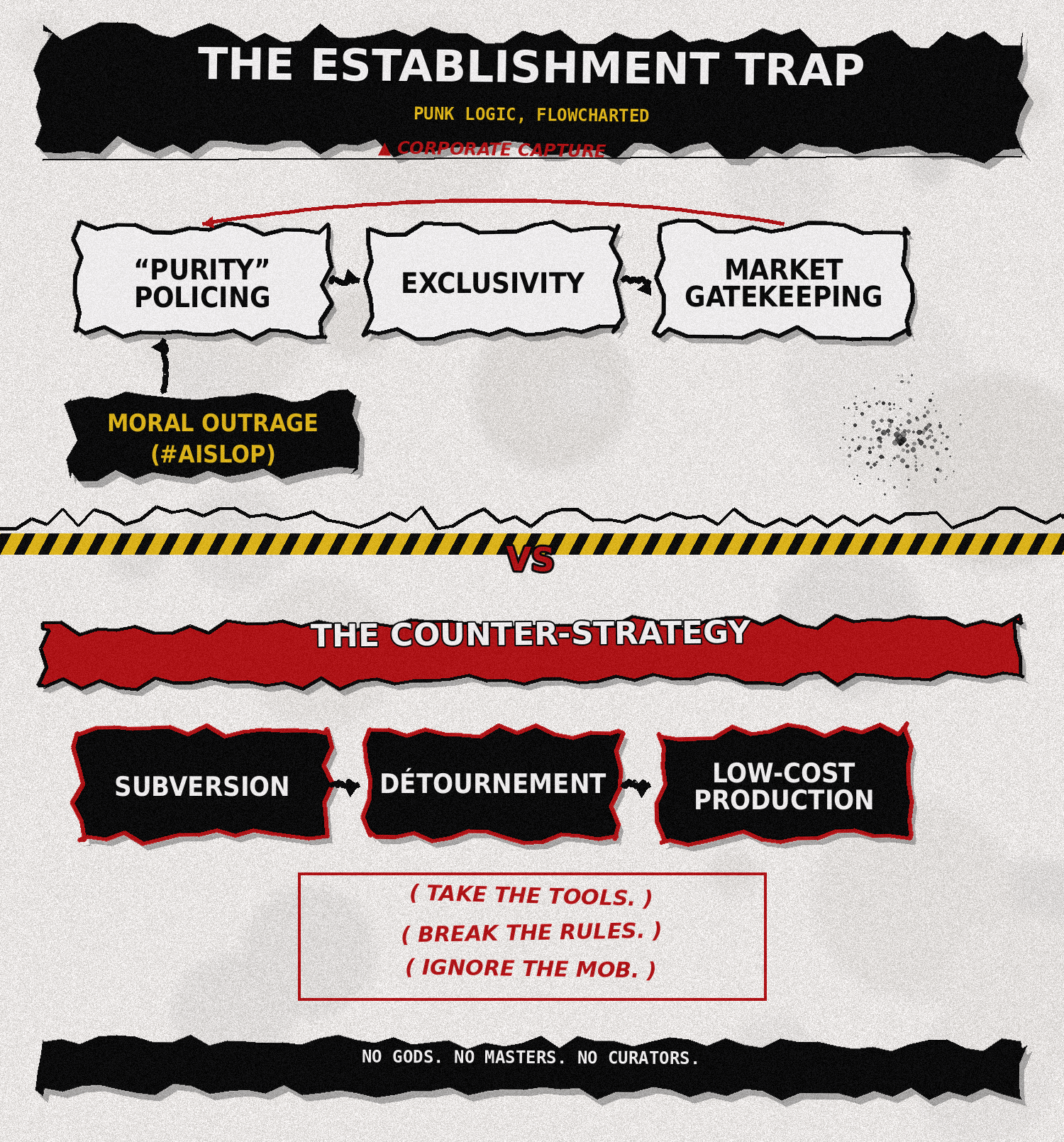
The truly subversive act has never been the polite observance of copyright law or the performative shaming of peers on corporate social feeds. It lies in seizing the instruments of the prevailing technological era, breaking their intended utility, and using them to make something filthy, immediate, and free. Punk is not an acoustic guitar played with clean hands; it is the refusal to ask for permission.
References
- Adorno, T. W., & Horkheimer, M. (1944). Dialectic of Enlightenment. New York: Social Studies Association.
- Benjamin, W. (1935). The Work of Art in the Age of Mechanical Reproduction. Zeitschrift für Sozialforschung.
- Debord, G., & Wolman, G. J. (1956). A User's Guide to Détournement. Les Lèvres Nues, No. 8.
- Fisher, M. (2009). Capitalist Realism: Is There No Alternative? Winchester: Zero Books.
- Reynolds, S. (1998). Energy Flash: A Journey Through Rave Music and Dance Culture. London: Picador.
- Plant, S. (1997). Zeros and Ones: Digital Women and the New Technoculture. London: Fourth Estate.