Field Essay: The Conveyor-Belt Soul and the Synthetic Heresy
How does a listener justify dismissing a track with incisive, razor-sharp political lyrics and radical sonic dissonance simply because its audio stems were synthesised by a neural net, while unironically praising a puerile, focus-grouped pop track that sounds like an insurance advert?
Part 2 of 3
Written by Lloyd Lewis
There is a grotesque, institutionalised doublethink operating at the heart of contemporary music consumption.
A listener will happily submit their nervous system to a relentless stream of four-chord, pitch-corrected, hyper-compressed pop effluent—churned out by a syndicate of six corporate song-doctors, polished to a lifeless gloss with Antares Auto-Tune and Melodyne, mathematically focus-grouped for thirty-second TikTok retention, and bankrolled by a multinational conglomerate. They will call this profound, emotionally resonant, and unequivocally "human."
Yet, the moment an independent creator feeds a venomous, razor-sharp political broadside into a neural synthesis model—generating a feral, abrasive counter-cultural track with zero budget, zero label oversight, and zero institutional permission—that exact same listener recoils in manufactured horror. They scream #AISlop. They run to social media to proclaim the death of art. They brand the synthetic track "soulless," "lazy," and an existential assault on the "human spirit."
This is not aesthetic discernment. It is a mass Stockholm syndrome cultivated by decades of corporate culture-industry conditioning.
I. The Industrialised Veneer: Standardisation as "Humanity"
The accusation that machine learning generates "derivative mediocrity" conveniently ignores that the mainstream music industry industrialised derivative mediocrity nearly a century ago.
Theodor Adorno's seminal diagnosis of musical standardisation in On Popular Music (1941) identified that mass-produced commercial music operates via rigid, pre-digested formulas designed to trigger Pavlovian emotional responses while pretending to offer novelty. Adorno termed this "pseudo-individualisation": the cosmetic illusion of unique artistic personality plastered over a strictly rationalised, industrial template.
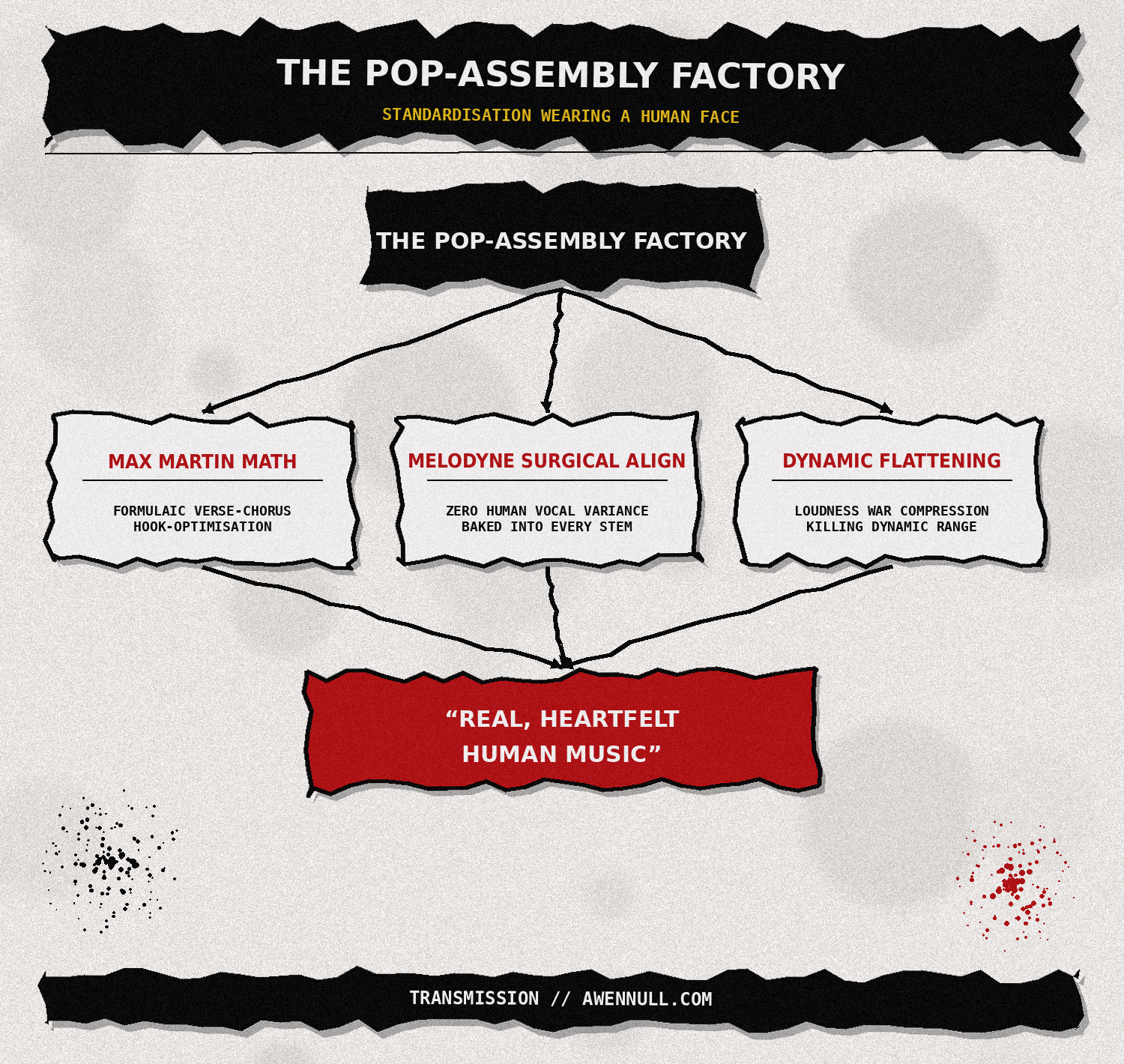
For the last thirty years, commercial pop, stadium country, and manufactured rock have abandoned even the pretence of organic human imperfection:
- Algorithmic Songwriting Pre-AI: As John Seabrook documented in The Song Machine: Inside the Hit Factory (2015), major labels long ago decoupled songwriting from singular vision. Tracks are engineered by assembly lines using strict metric templates, harmonic repetition, and algorithmic hook testing.
- The Surgical Grid: Human vocal performance is routinely dismantled in software, pitch-corrected note-by-note until microtonal inflections are scrubbed out, and quantised to a rigid millisecond grid that eliminates organic human groove.
- Acoustic Lobotomy: The end product is dynamic-range-compressed into a uniform brick of sound designed solely to survive car-radio noise floors and supermarket elevator speaker cones.
Yet because a biological body signed the contract and sat in the vocal booth for forty minutes while a paid engineer comped 120 takes into a synthetic composite, the audience celebrates it as an act of raw, untamed human expression. They are worshipping an industrial composite while imagining they are communing with a soul.
II. The Fetish of the Biological Meat-Puppet
How does a listener justify dismissing a track with incisive, razor-sharp political lyrics and radical sonic dissonance simply because its audio stems were synthesised by a neural net, while unironically praising a puerile, focus-grouped pop track that sounds like an insurance advert?
The answer lies in what Jean Baudrillard termed hyperreality and the simulation of authenticity (Simulacra and Simulation, 1981). Late capitalism no longer sells objects or even music; it sells the sign of authenticity. The music industry does not sell art; it sells a brand narrative attached to a biological meat-puppet.
The consumer has been trained to demand the signifier of the human (the press photo, the curated personal trauma on TikTok, the parasocial marketing campaign) over the actual substance of the work. If the signifier is absent—if the audio emerges from the latent space rather than a media-trained celebrity—the listener's cognitive framework collapses. Unable to consume the parasocial persona, they declare the art itself non-existent.
This is ideological cowardice. A brutal, poetic counter-cultural critique of state surveillance, class war, or technocratic collapse does not lose its intellectual or aesthetic force because its vocal delivery was rendered by silicon rather than a vocal cord. To argue otherwise is to argue that poetry ceases to be poetry the moment it is printed with movable type rather than hand-scribed onto calfskin by an illiterate monk.
III. Cybernetic Authorship and the Ghost in the Tool
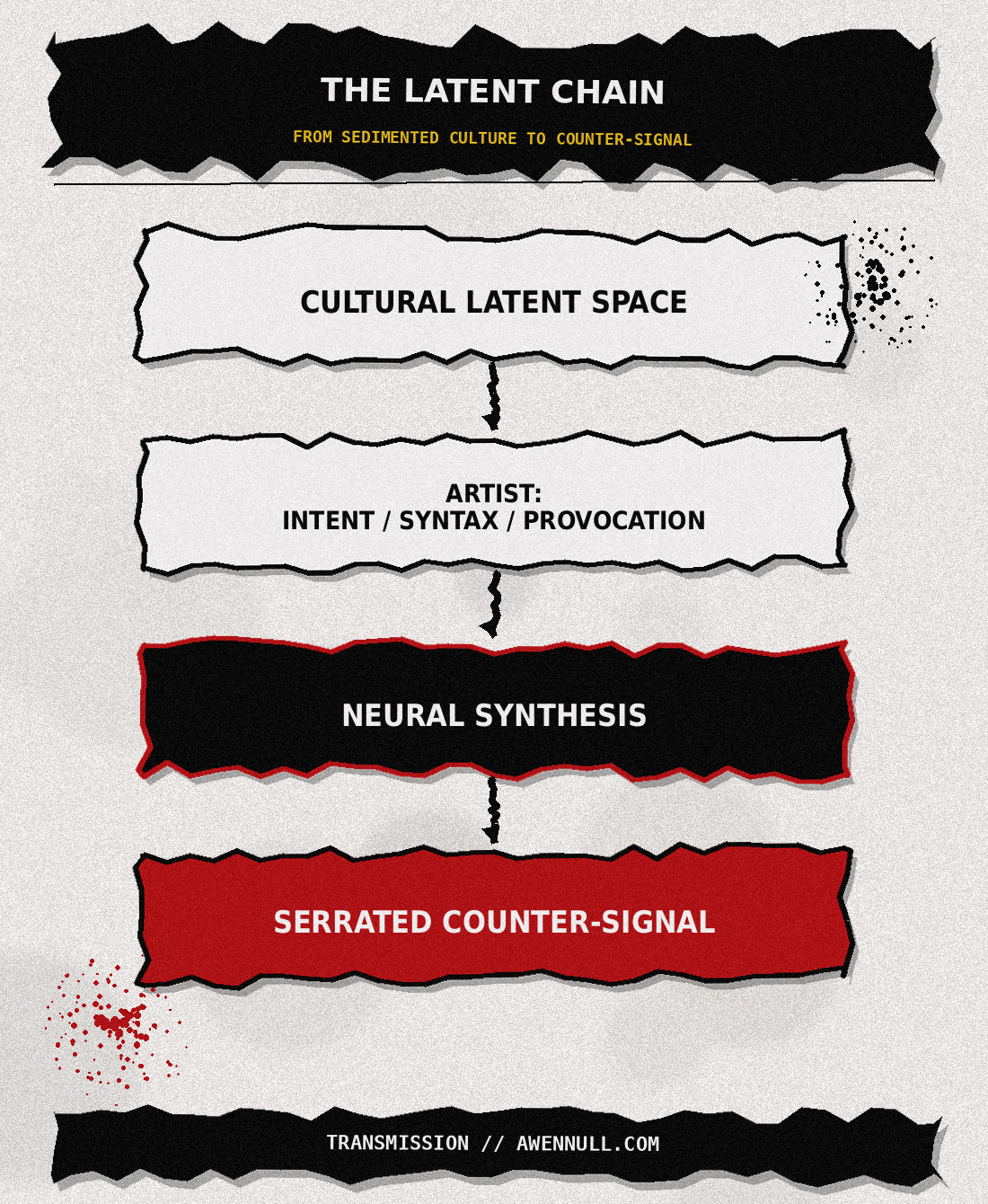
The myth of the solitary, pure author was thoroughly dismantled decades ago. In The Death of the Author (1967), Roland Barthes argued that a text is not a line of words releasing a single "theological" meaning (the message of the Author-God), but a multidimensional space in which a variety of writings, none of them original, blend and crash.
Machine learning models are the literal materialisation of Barthes' text: vast, collective latent spaces holding the entire sedimented history of cultural recording.
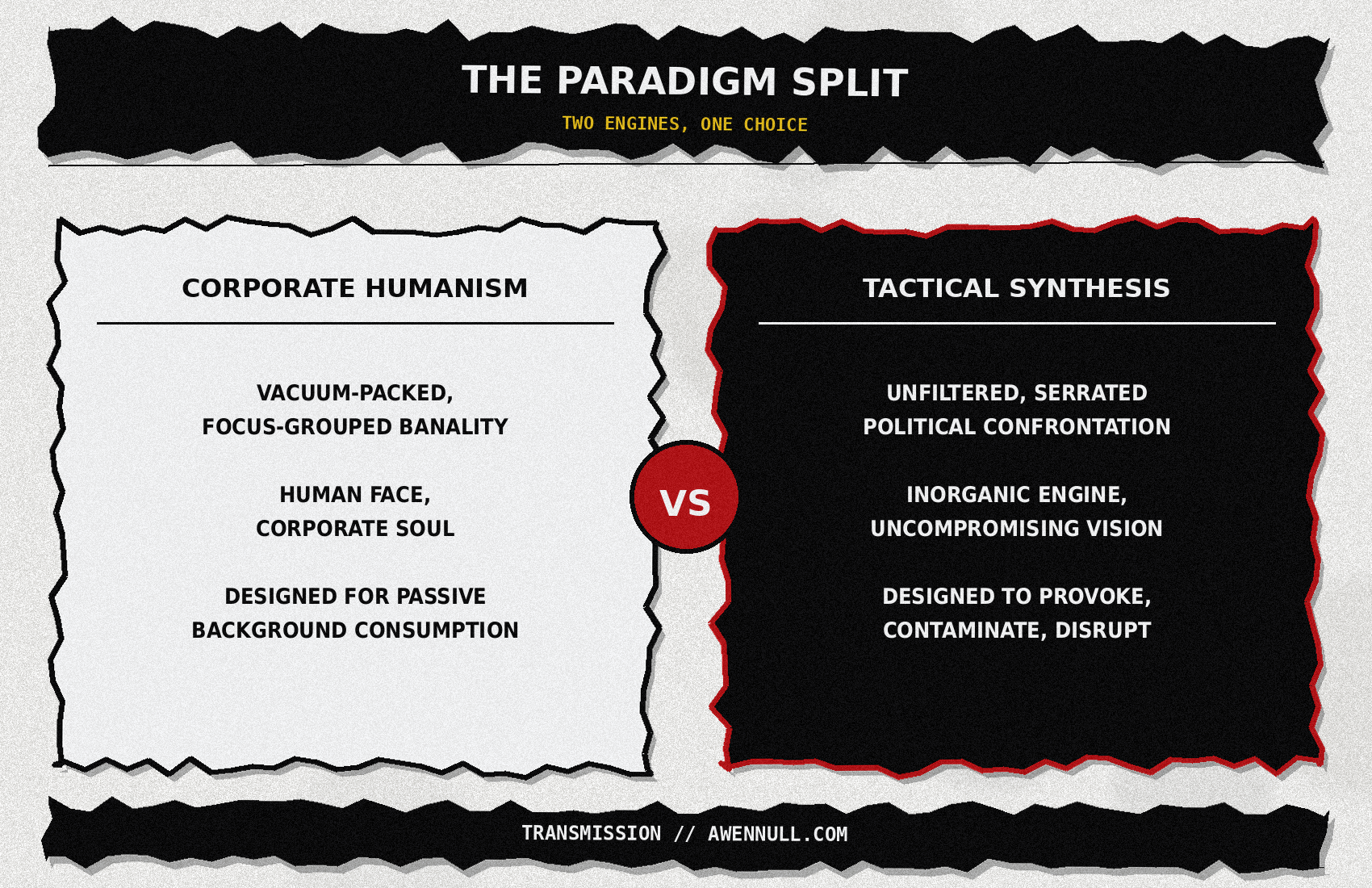
When an artist uses a generative model, the artistic act shifts from the manual physical execution of a single instrument to the architecture of intent:
- The curation and synthesis of concepts.
- The collision of disparate political philosophies and visceral semantics.
- The high-speed interrogation and perversion of the training data.
The idea that manually playing an acoustic guitar guarantees "soul," while architecting a devastating political audio track using neural synthesis constitutes "slop," is an aesthetic relic. It reduces art to mere physical athletics—gymnastics for the ears.
True art is not defined by the calorie expenditure of the person producing it; it is defined by the rupture it creates in the consciousness of the person experiencing it.
IV. The Subversive Choice
The modern music industry is terrified of algorithmic generation not because it lowers artistic quality—quality was sacrificed for market predictability decades ago—but because it destroys their monopoly on production. They cannot gatekeep an infinite studio that runs locally on commodity silicon.
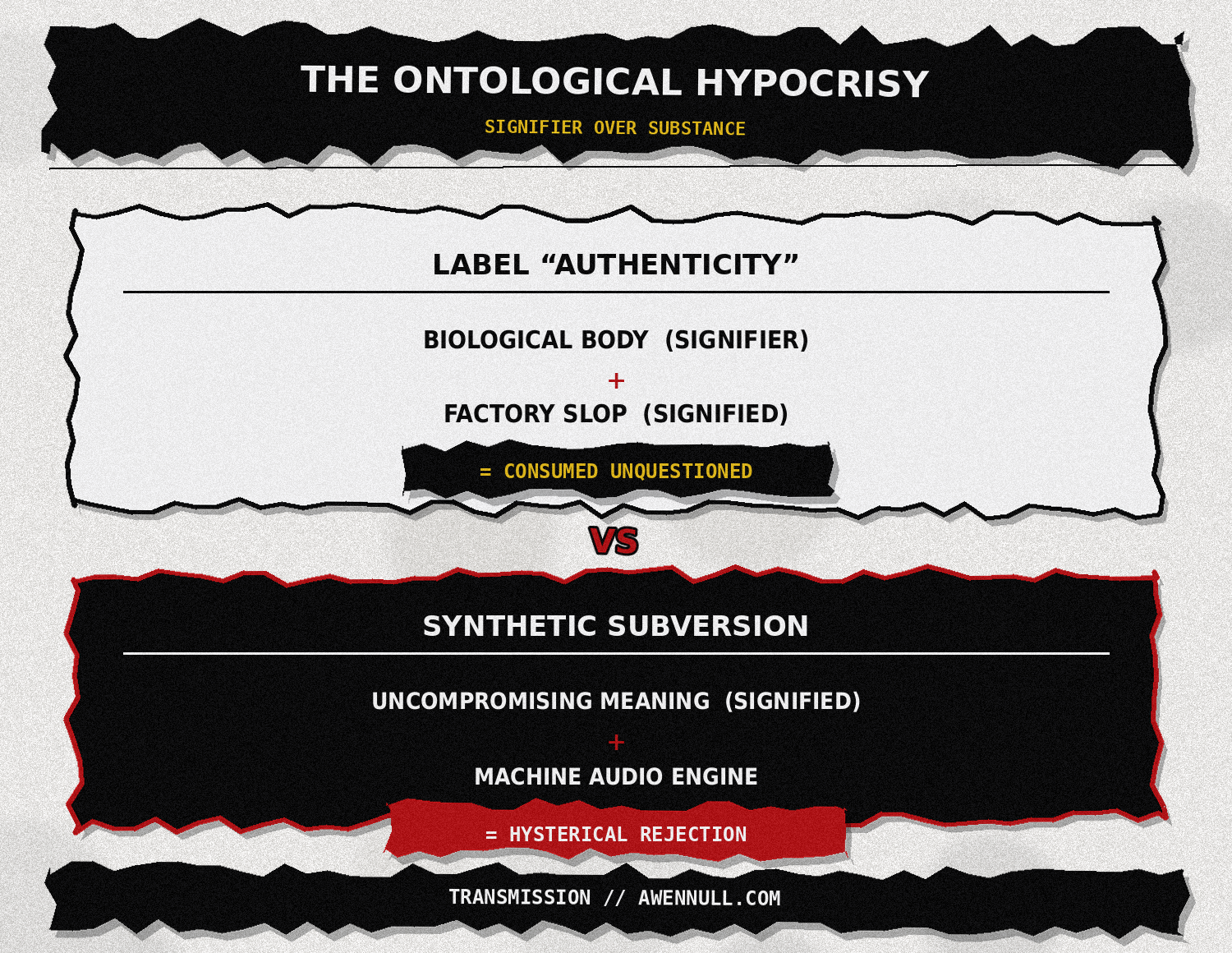
The listener who ignores an incandescent, subversive piece of machine-assisted political agitation to retreat into the safe, pasteurised arms of corporate playlist pap is not taking a principled stand for humanity. They are taking a stand for the brand managers, the DSP monopolies, and the automated homogenisation of the culture industry.
Embracing synthetic audio generation to deliver uncompromising, hostile messages is not the betrayal of artistic integrity. It is the refusal to accept that the only valid art is the sanitized, focus-grouped slop the industry has spent fifty years training you to swallow.
References & Source Nodes
- Adorno, T. W. (1941). On Popular Music. Studies in Philosophy and Social Science, 9(1), 17–48.
- Barthes, R. (1967). The Death of the Author. Aspen, No. 5–6.
- Baudrillard, J. (1981). Simulacra and Simulation. Éditions Galilée.
- Fisher, M. (2014). Ghosts of My Life: Writings on Depression, Hauntology and Lost Futures. Zero Books.
- Seabrook, J. (2015). The Song Machine: Inside the Hit Factory. W. W. Norton & Company.
- Taylor, T. D. (2001). Strange Sounds: Music, Technology and Culture. Routledge.
Part 1 of 3 below 👇
 FACELESS