The Hybrid Score, Latent Archaeology, and the Ghost in the Groove
The future of counter-cultural music does not belong to the puritanical preservationists screaming at code, nor does it belong to the corporate software vendors peddling frictionless, bland automation.
Part 3 of 3
Written by Lloyd Lewis
The loudest puritans in the room always operate on a cartoon binary: human flesh on one side, silicon coldness on the other. They imagine a zero-sum war where neural synthesis either entirely replaces biological musicianship or gets banished by the moral crusade of the artisanal guild.
This false dichotomy betrays a profound illiteracy regarding how music has functioned for centuries.
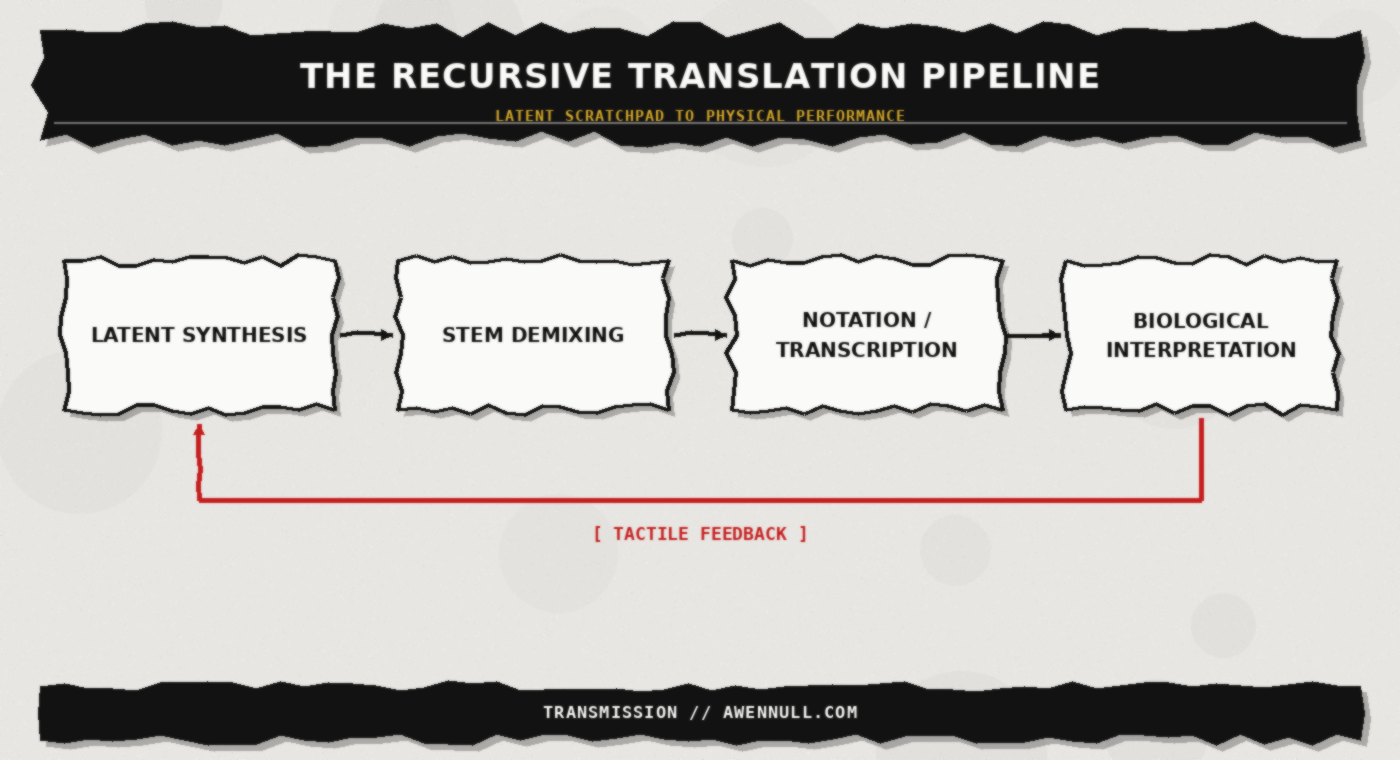
When a composer or producer uses neural models to architect raw, serrated compositions, separates the resulting audio stems, transcribes them into manuscripts, and hands those charts to human instrumentalists to perform, they are not erasing the human element. They are engaging in an ancient, recursive lineage of musical translation. They are treating the latent space as a generative scratchpad — an unhinged collaborator whose hallucinations are pulled back across the threshold into physical reality through breath, wood, brass, and blood.
I. The Score as Historical Machine Code
The notion that music must originate purely from the unmediated physical instinct of an individual performer is historically illiterate.
For hundreds of years, Western composition has relied on a cold, abstract, and symbolic protocol: musical notation. As Lydia Goehr demonstrated in The Imaginary Museum of Musical Works (1992), the emergence of the work-concept turned the score into an autonomous, abstract blueprint. A 17th-century orchestral player receiving a manuscript by Bach or a 19th-century player receiving a chart by Mahler was not communing psychically with the composer's immediate physical presence. They were interpreting a spatialised, symbolic script — translating dry marks on a page into acoustic resonance.
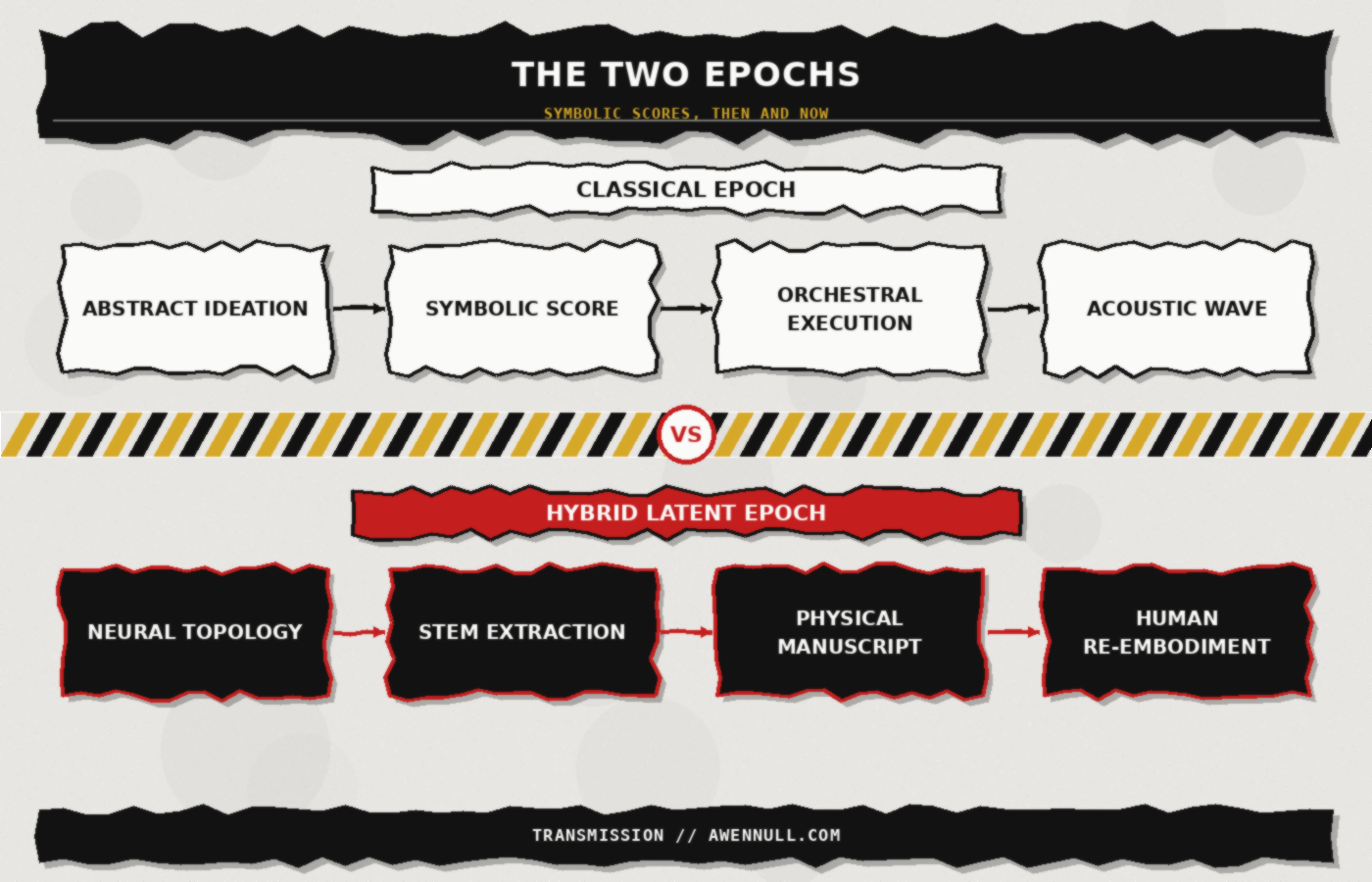
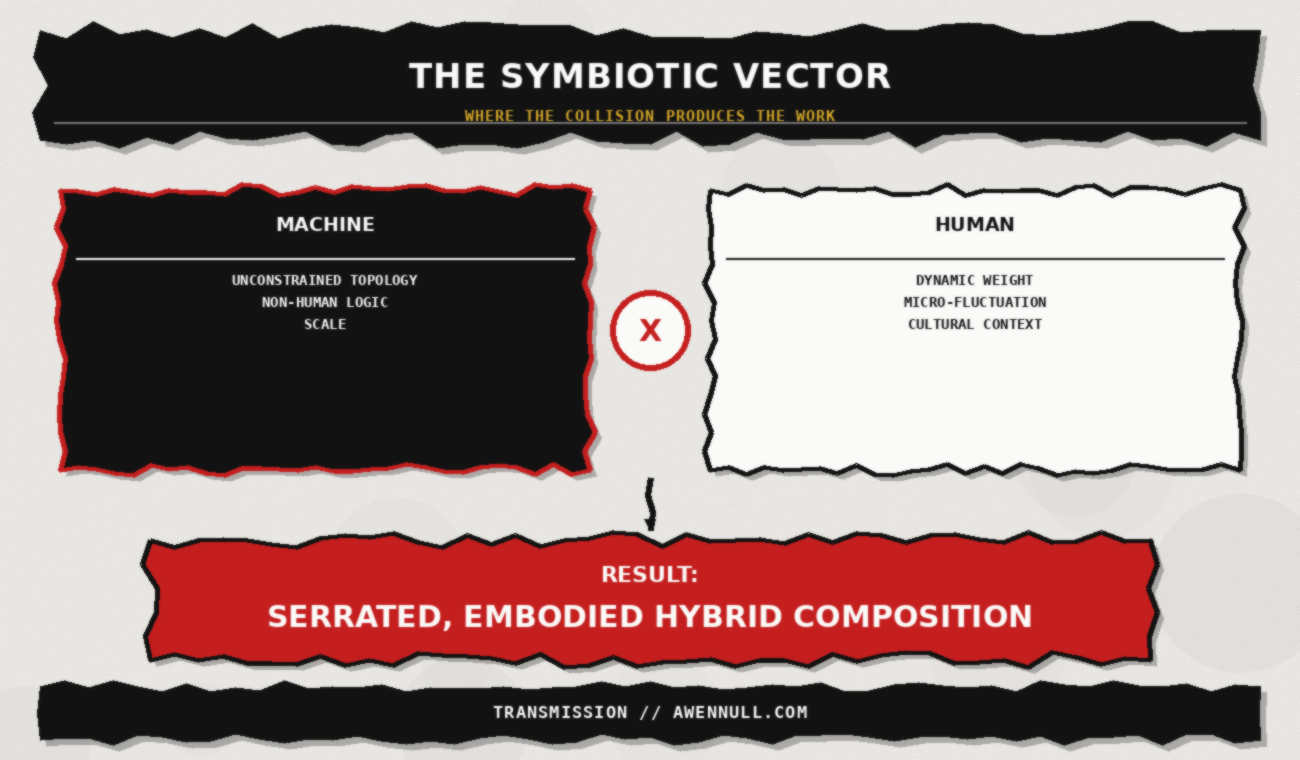
When a contemporary composer uses neural networks to generate impossible polyrhythms, unexpected harmonic collisions, or microtonal counterpoints, extracts the stems, and drafts a score for a live ensemble, the process is identical. The machine provides the architecture; the human performer provides the friction, micro-timing, and biological interpretation.
The musician is not displaced; they are handed entirely new harmonic and rhythmic vocabularies that biological composition habits — constrained by muscle memory and familiar fingerboard patterns — would never have stumbled across.
II. The Ergonomic Feedback Loop: Instruments Re-Invented
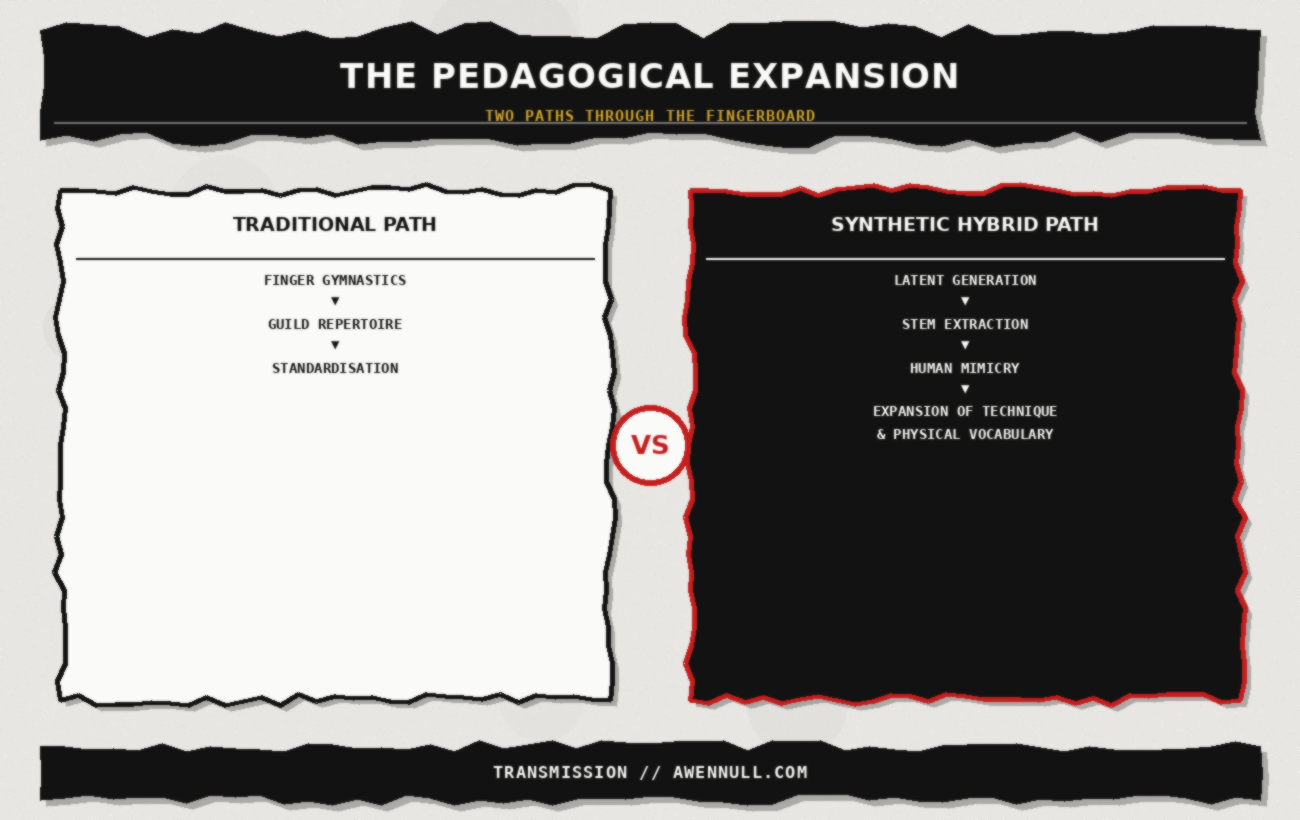
The panic that synthetic composition will deter people from learning physical instruments fundamentally misunderstands human curiosity. Every major technical disruption expands, rather than contracts, tactile engagement:
- MIDI and Digital Audio Workstations: When MIDI sequencing appeared in the 1980s, traditionalists declared the death of drumming and keyboard playing. Instead, it spawned generations of musicians who picked up bass, synthesisers, and drum kits precisely to replicate the alien grooves of sequenced electro and UK garage.
- The Chiptune and Math-Rock Vectors: Bedroom programmers generated impossible 8-bit arpeggios that human hands were never meant to play; twenty years later, bands like Battles and Polyphia reverse-engineered those machine constraints onto electric guitars and physical kits.
Machine learning generates wild, non-standard phrasing and timbre mutations. Transcribing an algorithmic phrase and forcing human fingers to negotiate its strange intervals does not kill instrumental craft; it violently revitalises it. It transforms traditional instruments from museum relics preserving nineteenth-century repertory into cybernetic decoding engines.
III. The Ontological Illusion: The Acoustic Voice vs. The Synthetic Signal
The core hypocrisy of the anti-AI brigade rests on a refusal to admit what a "recording" actually is.
Listeners routinely assign spiritual holiness to a WAV file of a biological human singing, while dismissing a synthesised voice as an unnatural, mechanical abomination. This distinction is purely psychological.
In The Form of the Phonograph Record (1934), Theodor Adorno pointed out that the moment sound is captured onto physical or magnetic media, it undergoes radical reification:
"The record turns the acoustic event into an object... It is not the music itself, but its petrified hieroglyph."
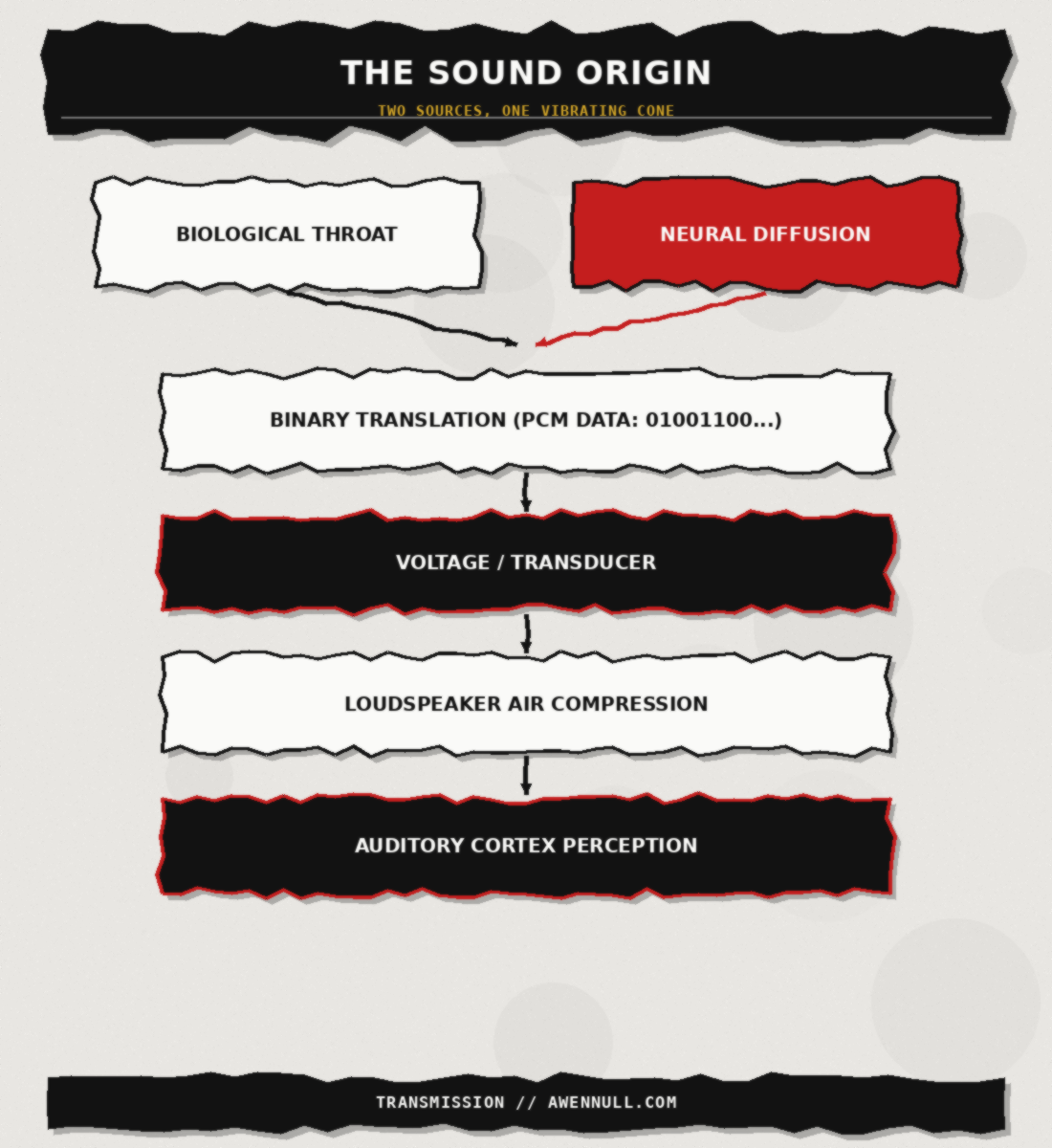
A recording of a dead tenor singing an aria is not a human being. It is an electromagnetic shadow. It is an arrangement of microscopic magnetic orientations on tape, pits on an optical disc, or binary floating-point numbers on an SSD. It is a synthetic simulation that forces a loudspeaker cone to vibrate in a manner that tricks the primate ear into inferring a presence that is not in the room.
As the classical pianist and recording theorist Glenn Gould argued in The Prospects of Recording (1966), recording technology long ago dismantled the concept of "acoustic realism." Gould abandoned the concert hall entirely, asserting that the studio composite — constructed through splices, overdubs, and post-production manipulation — was fundamentally superior because it abandoned the theatrical illusion of pure physical presence.
At the level of playback, a recorded human voice and a generated neural voice are ontologically identical: they are both encoded electrical voltages driving a coil. To worship one as an authentic repository of the human soul while decrying the other as "inorganic slop" is a primitive form of technological animism.
IV. The Line Is Already Gone
The boundary between machine artifact and human expression has never been clean, and it never will be.
The future of counter-cultural music does not belong to the puritanical preservationists screaming at code, nor does it belong to the corporate software vendors peddling frictionless, bland automation.
It belongs to the scavengers, producers, and players who sit in the middle: those who will take an ungodly algorithmic signal, slice its stems to ribbons, print the parts out onto paper, and hand them to four live players in a damp room to see what happens when the human nervous system collides with the machine's dreams.
That is not the death of craft. It is the continuation of the experiment.
References & Source Nodes
- Adorno, T. W. (1934 / 1990). The Form of the Phonograph Record. (Trans. Thomas Y. Levin). October, Vol. 55, 56–61.
- Goehr, L. (1992). The Imaginary Museum of Musical Works: An Essay in the Philosophy of Music. Oxford: Clarendon Press.
- Gould, G. (1966). The Prospects of Recording. High Fidelity Magazine, 16(4), 46–63.
- Kittler, F. (1999). Gramophone, Film, Typewriter. Stanford University Press.
- Rothenberg, D. (2002). Suddenly Almost Human: Machines Making Music. In Parables for the Virtual. Duke University Press.
- Wishart, T. (1996). On Sonic Art. Routledge.
Previous parts in this series: 👇
 FACELESS
 FACELESS